

Albert Einstein is often quoted as saying, “We still do not know one thousandth of one percent of what nature has revealed to us.”
As people drive down the highway, surrounded by others on the road, it has become the norm to become oblivious to the nature that surrounds us.
While ancestors relied on the knowledge of what certain trees and plants are and how they can help or hurt you, that knowledge is no longer necessary for survival.
As the general understanding of nature has dwindled, so has respect for it.
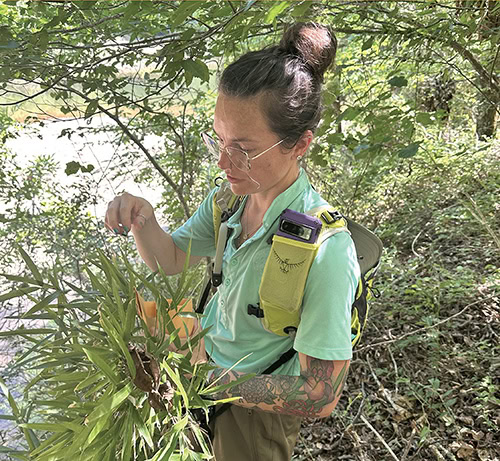
Jamie Smith, an environmental specialist with the Choctaw Nation, has a plan to turn that around, at least a little bit. Smith recently completed writing and photographing Culturally Significant Plants of the Choctaw Nation Reservation.
Jamie Smith
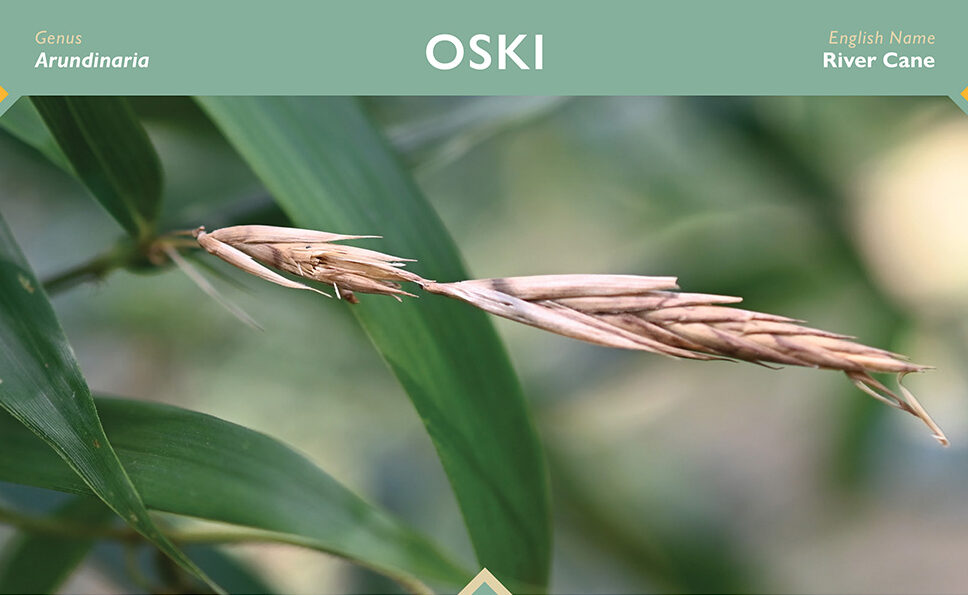
“I would say river cane is my favorite. It’s such a fascinating plant to me. There’s a lot of mystery to it, scientifically speaking. It has a lot of research gaps that I’m trying to fill.
Its population is very threatened, but lately, there’s been a lot more people interested in the plant itself, so it’s finally getting some well-deserved attention. We could say its population numbers are starting to grow, but that’s not confirmed. Botanically, it’s a weird plant, and it’s just really cool.”
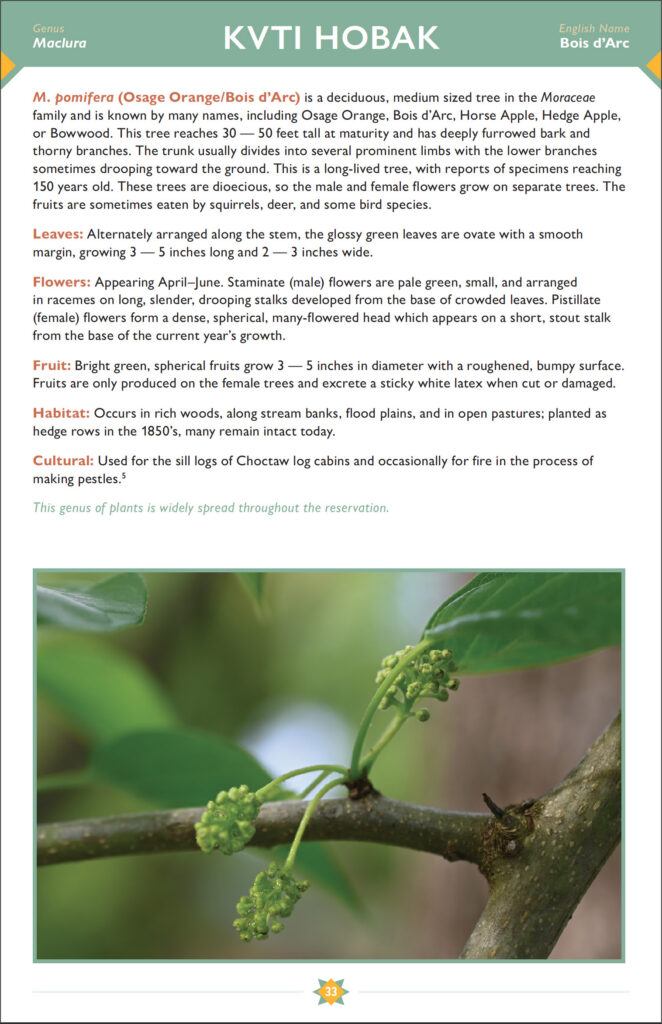
The book is a field guide to native plants on the reservation. It also includes Choctaw language and cultural knowledge, making it stand out from other guides.
Smith, who has a tendency to collect field guides, said, “I thought it would be a unique idea to be able to do this and have it as a resource for tribal members.”
The idea for the book started during budget meetings when her department director asked for suggestions for using Environmental Protection Agency General Assistance Program (GAP) funding.
“I get so many people asking me what those yellow flowers are right now. I usually know what it is and can say it’s probably one of three flowers that you’re seeing. So, I thought that this would be a good thing to have as a resource,” Smith said.
Smith graduated from Southeastern Oklahoma State University (SOSU) with a Bachelor of Science in biology with a special emphasis in botany.
According to Smith, it took about two years to put the book together.
“I spent at least the first year just researching historical uses of these plants by Choctaw people specifically,” she said.
Smith started with a list of 300 plants but had to narrow it down.
“I decided the criteria had to be that the plant had to have a Choctaw name or Choctaw word and then a documented Choctaw use, and it had to be present on the landscape today.”
Putting the book together was a lot of work, but Smith relied heavily on her coworkers’ help.
“I have a really amazing team of people that I work with,” Smith said. “My supervisors and managers are wonderfully helpful, and they are the reason that I was able to do this because they are very understanding of our team.”
Smith also relied on help finding some of these plants.
“When we go out in the field, we always have another couple of people with us. So, there were days when I would pull up a list from iNaturalist.org and say I’m looking for these five types of trees to get a picture of it and to confirm that it’s here,” Smith said.
Smith grew up in the woods of Pushmataha County and is glad she can now work with nature as her job.
According to Smith, the most difficult part of the process was when all the research was done, and she needed to start writing the book.
“The hardest part was being able to write it in a way that is not going to make everyone’s eyes glaze over,” said Smith.
Her goal was to write it so that she didn’t sound like a botany professor. She wanted to make it easily digestible so that anyone could figure out what a certain plant looks like and find it on their own.
That also served as a learning experience for Smith.
“I think that the technical writing part of it, to make it not so technical, is probably what taught me the most,” said Smith.
Her goal for the book is to create more awareness of the nature that surrounds us.
“I want to have a way to have more people familiar with the plants that we see around us. To know what they are and to know that some of them have uses,” Smith said.
Traditionally, the plants in the book have been used for food, construction, textiles and medicine.
In the book’s introduction, Smith explains that during her research, she found several medicinal uses recorded by botanists and naturalists.
By listing these medicinal uses, Smith hopes to show that these historical accounts remain relevant and that the plants are still available and can still be used.
Smith wants to raise awareness of native plants and their uses, as well as the importance of reducing plant blindness. If a plant can be used to help stop bleeding or heal a cut (Yarrow – Fvni hasimbish holba), that is an added bonus.
If you want to learn about plants on the reservation, Smith suggests going with someone experienced in foraging or wildcrafting.
“Don’t go out and just start eating stuff,” said Smith.
Smith said it’s important to use multiple resources to confirm what you’re seeing, because even touching the wrong plant can be dangerous. She also encourages people to leave more than they take when foraging.
Many of the plants used by early Choctaw people in Mississippi are also native to the reservation.
Smith’s book, which raises plant awareness among the current generation, is one way she is helping to preserve Choctaw culture.
Copies of the field guide can be found at select Community Centers and at Choctaw Nation and community-hosted in-person events.
More information is available at Culturally Significant Plants of the Choctaw Nation Reservation.