

March 22 marks World Water Day, which highlights the importance of sustainable management of freshwater resources.
Water in the Choctaw Nation has always served as a vital corridor for our culture, subsistence, trade and transportation.
This World Water Day, Choctaw Nation is focusing on the people who keep our water systems working and make sure clean water gets to our homes and businesses.
While often overlooked when talking about water on the reservation, water operators are vital to keeping this essential system running.
Despite water’s instrumental role in everyday life, rural water systems face unique challenges that sometimes make water treatment and delivery difficult.
In recent years, the cost of materials and chemicals has increased by 200% to 700%. Fixing a leak can cost about $10,000 to $12,000, but only if the right materials are available. Rural water systems often struggle to keep the necessary parts in stock while operating within an aging water infrastructure.
On a “good month,” Sardis Lake Water Authority (SLWA) addresses 4-6 leaks, but they never know when and where these leaks will occur. Being a water operator can be a 24-hour job, one that often has you working Thanksgiving and Christmas.
Sometimes, a rural water system is run by just one full- or part-time employee, with help from volunteers who step up to fill important roles.
“We never know day to day what is going to happen,” Chris DeWeese, SLWA’s Chief Superintendent, explains. “We don’t know if it’s going to be an early day or late night. It is rarely an early day.”
DeWeese’s office is responsible for over 350 square miles of pipes and supplies treated water to the towns of Clayton and Nashoba, Pushmataha County Rural Water Districts #1 and #5, and Latimer County Rural Water District #2. DeWeese views all of these organizations as fingers on his hand with SLWA as the palm – if one fails, they all fail.
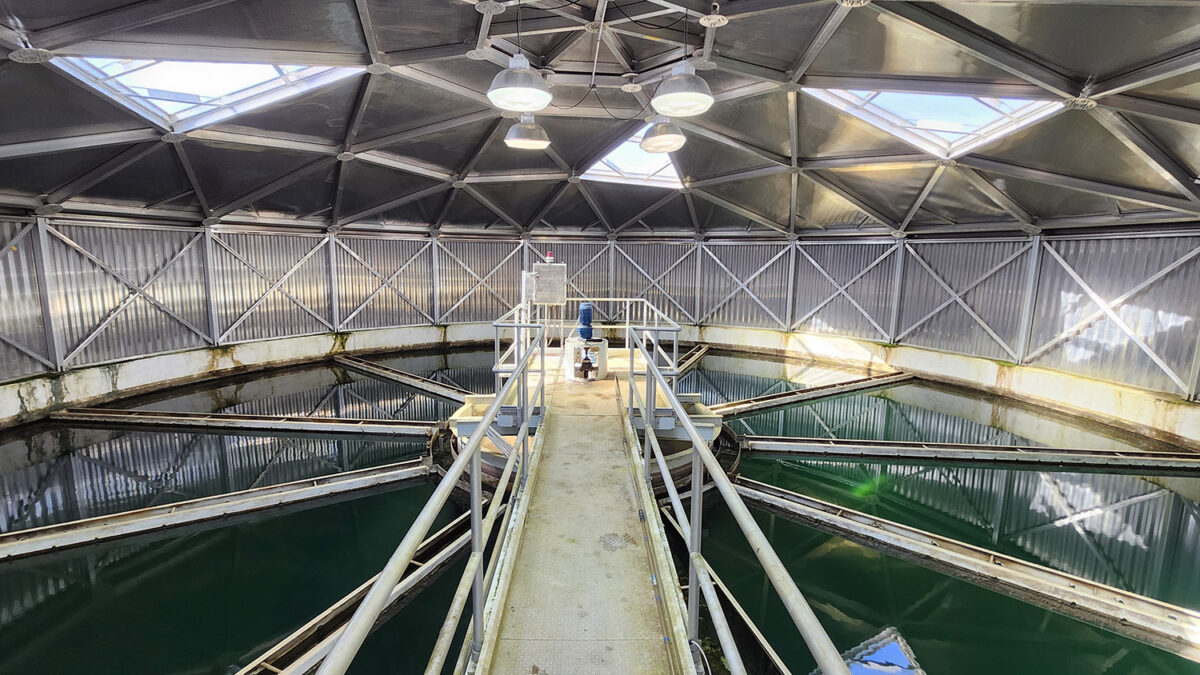
The water from his treatment plant serves about 5,500 people, including schools, clinics, restaurants, gas stations, senior apartments, daycares and apartments.
His team responds to water leaks, customer calls, county assistance requests and 811 requests to find water lines.
DeWeese starts his day by conducting seven water tests, including testing for pH, alkalinity, hardness, magnesium, iron, clarity and sludge content. The water is tested as it enters the system and as it leaves after treatment.
Treatment methods depend on factors such as weather, season, water source, local environment and surrounding land use. Water quality can change daily or even hourly.
To anticipate water conditions and prevent issues, 25 additional tests are run daily at locations across the service area.
Because water conditions change so much, water operators have to be like chemists, mechanics, investigators, geologists, mathematicians, engineers, electricians, plumbers and carpenters all at once. In rural areas, water operators often lack traditional training; everything is learned on the job and earned the hard way – when issues arise.
DeWeese’s dedication to his role in the community represents the Chahta Spirit.
“Chris is always the first in line to help anyone in need, and he never asks for anything in return,” said Jeremy McBride, Sustainable Communities Manager for the Choctaw Nation’s Office of Water Resource Management (OWRM).
His volunteer work includes providing donated materials and time to help water outages in Pushmataha Rural Water Districts #3 and #5 at no cost to either system, providing leak detection and technical assistance to the town of Arkoma, Haskell County Water Corporation, the SLWA systems that utilize his plant’s treated water, and traveling to assist with the water system impacted by the Cherokee County fires in early 2025.
According to DeWeese, his work is a necessity. In roles that are often misunderstood or overlooked, like water treatment, DeWeese believes in helping others and sharing what he knows whenever possible.
“Nothing we do is proprietary; everything should be shared, including knowledge and resources. Operators learn what they can, but more importantly, they help each other,” said DeWeese. “If we don’t take care of each other, we don’t get help.”
DeWeese says he truly understood the importance of his role during his time in Cherokee County.
DeWeese, along with Rayna Noah, SLWA’s office manager and Hunter Noah SLWA Field Supervisor, went to Pawnee, Okla., to help their water operator after wildfires decimated the area in early 2025. They spent four days in an area so badly burned that water meters had melted.
With limited water to address the catastrophe, Pawnee represented the extreme of a system so instrumental to our quality of life but so underfunded in rural areas.
“It wasn’t Sardis and Pawnee, it was all of us together. It gave me a better sense of why we do what we do,” said DeWeese.
When DeWeese took the helm at Sardis Lake Water Authority in 2021, it was one of the worst-run water treatment plants in the state.
The plant is over 20 years old and has been failing rapidly. Underbuilt from the start, it has not been well-maintained over the years. Now, SLWA’s positive transformation is the topic of water professionals nationwide.
DeWeese, Noah and their dedicated team have worked tirelessly to ensure the water treatment plant’s success.
“The guys I have hired aren’t here just for a paycheck. We eat and breathe water management,” said DeWeese. “I always say, water people are not born, they are made, and it becomes their life.”
In addition to his dedicated team, numerous organizations are working together to create an ironclad partnership that has provided expertise, funding and support.
These include the USDA, the Oklahoma Department of Environmental Quality, the Oklahoma Water Resources Board and the Choctaw Nation.
With these partnerships, SLWA has secured over $20 million in funding for a new water treatment plant, an accomplishment that would not have happened without this teamwork.
Though the new plant is still a few years away, DeWeese and his team have already cut water loss from 50% down to the gold standard of 1-10%. Most water systems lose about 20%.
Even with limited updated materials, equipment and manpower, response time to leaks has been cut in half, saving both the water treatment plant and the customers it serves significant money.
“There is not a water system in the world that doesn’t struggle,” said DeWeese. However, SLWA represents a cautionary tale that has become a gold-standard operation despite its dated equipment.
Because citizens are central to rural water systems, it’s important for everyone to know where their water originates and how it is treated before it reaches their taps. SLWA invites citizens to attend monthly water board meetings, where they share monthly updates on the plant, leaks and finances.
These meetings are a great way to get to know who manages your water and what they do. Meetings are posted at the SLWA’s physical office and at sardislake.myruralwater.com.
SLWA also encourages its customers to reach out if they have an issue.
“We can’t address the problem unless we know there is one,” said Noah.
The Choctaw Nation’s Office of Water Resource Management (OWRM) operates under one goal: long-term sustainability of the water resources within the Choctaw Nation of Oklahoma Reservation.
To support this goal, OWRM is offering free Water Operator Renewal Training for certified water operators in Oklahoma.
The training will offer hands-on instruction focused on the operational, maintenance, and regulatory aspects of water treatment systems and facilities.
Participants will earn the in-person continuing education hours required to renew their Oklahoma water operator licenses.