

Ashley Banks had been dealing with severe back pain for two years. Different doctors gave her different diagnoses, some including anxiety and caregiver burnout. Banks said those diagnoses just didn’t feel right.
What she found at the Choctaw Nation McAlester Clinic was different. A friend recommended that she visit Dr. Daniel Stacy at the clinic. Banks said Dr. Stacy took the time to listen, ordered thorough blood work and, most importantly, followed up with her, something she says none of her other doctors had done.
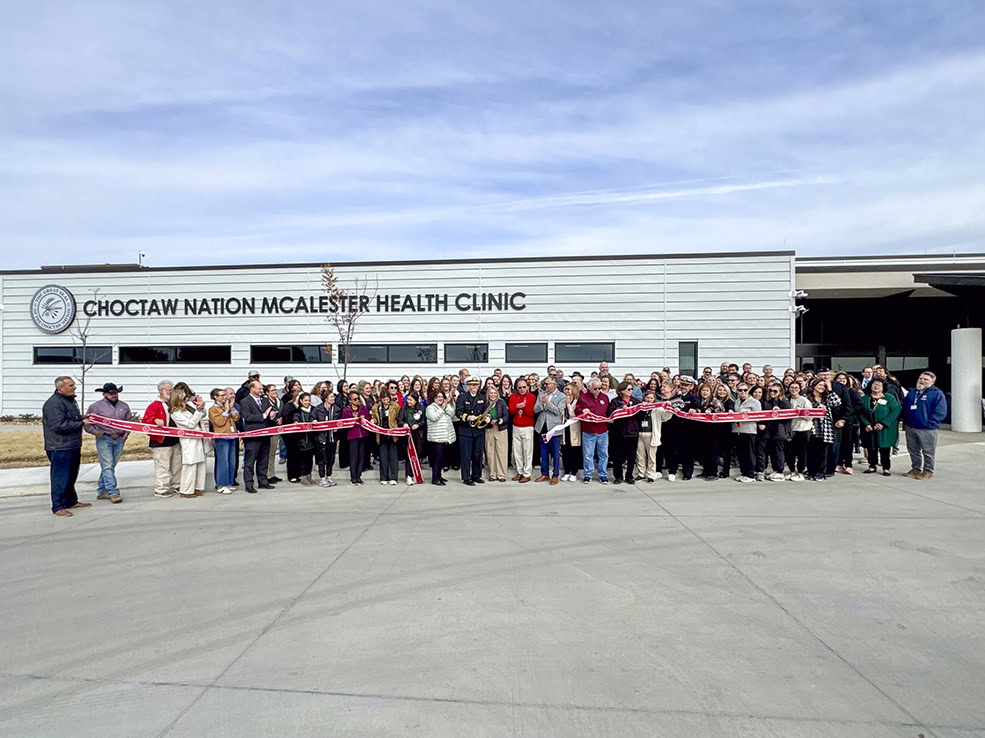
Banks’ experience shows what can happen when primary care physicians have the time and space to do their jobs without being rushed. That’s exactly what the Choctaw Nation’s expanded McAlester Clinic is designed to provide.
The McAlester Clinic, which originally opened in 2007, is undergoing significant upgrades. The expansion more than doubles the facility’s square footage from about 50,000 to more than 100,000 square feet, bringing together services scattered around the McAlester area and, at the same time, introducing state-of-the-art diagnostic equipment.
One of the clinic’s most significant upgrades is the new Hologic mammography machine, making it the first Choctaw Nation clinic with the equipment.
The machine offers benefits that go beyond standard mammography. According to Hologic, it provides a clearer, layered view of breast tissue, reducing callbacks by 32%. That means fewer false positives and fewer callbacks for additional testing.
“It’s the current gold standard, so we were able to switch over to it,” said James Haley, clinic operations director. “We are unique in that we are the first ones to have it,” he said.
The clinic has also expanded its diagnostic imaging capabilities. McAlester now has a CT machine, making it the third Choctaw Nation clinic to offer CT scanning. The old building only had one X-ray machine; the expanded clinic now has two. Ultrasound capacity has also doubled, from one to two machines.
But equipment is only part of the story. The same-day clinic now has its own dedicated space, separate from primary care. Before the expansion, same-day services were located within the primary care area.
Now, with dedicated space and three providers, the same-day clinic can operate independently while primary care physicians get more dedicated exam rooms.
Haley stressed what the same-day clinic was not for: “Same-day clinic, it is not an emergency room. It’s for coughs, colds, aches, sprains and rashes,” Haley said.
Primary care, by contrast, is where patients go for scheduled checkups, management of chronic conditions and more complex visits that require time and attention.
This separation matters more than it might seem. When primary care physicians aren’t dealing with the demands of the same-day clinic, they have time to notice the details that might be missed in a rushed appointment.
“Previously, they had at most two exam rooms. So now each provider in primary care has three exam rooms to use,” Haley said. “This really helps with the flow of seeing patients and getting them in and getting them seen.”
That breathing room is exactly what may have helped Dr. Stacy notice something was seriously wrong with Banks. When her blood work came back showing alarmingly high liver enzymes, he called her immediately with instructions.
“He called me immediately, as soon as he got the results and told me that basically, if I turned yellow, or if I started having pain again, I needed to go back to the emergency room,” Banks said.
When she did return to the ER showing signs of jaundice, the doctor initially didn’t take the concern seriously until her husband insisted that Dr. Stacy had sent her back in.
“Finally, the doctor listened, and he referred me to Fort Smith.” At Fort Smith, Banks was diagnosed with a severe gallbladder condition that would require immediate attention. Without Dr. Stacy, Banks said the situation could have been much worse.
“I was very impressed with Dr. Stacy,” Banks said. “He was very thorough. He was caring. He was nonjudgmental, and his follow-up was great,” Banks said.
The McAlester Clinic has also expanded its provider team. The pediatrics department has grown from three full-time providers and one part-timer to five full-time and one part-timer. Two new mid-level providers were added to the primary care team. And when the remodel is complete, specialty services will be available right at the clinic.
“We hired a second podiatrist, and we’re working on adding orthopedic and cardiology services a couple of days a week here at the clinic,” said Haley. “Which will help the patients from having to go to Talihina or Durant for that.”
The expansion will also bring patient relations and behavioral health services in-house, consolidating services that are currently spread across separate locations.
According to Haley, the clinic is expected to add 56 new staff members, bringing the total to about 200 employees. The expansion is projected to increase patient visits by 9,000 annually, a potential 65% increase.
For patients like Ashley Banks, the enhanced clinic means better access, better technology and more importantly, better care.
It means doctors have time to listen and make follow-up calls, the kind of attention that can save lives.
The McAlester Clinic expansion demonstrates the Choctaw Nation’s commitment to making quality healthcare, including advanced diagnostic technology and specialized treatment, available closer to home for its tribal members.
To schedule an appointment, call 918-423-8440 or use the MyChart app. For more information on other CNHSA services, visit cnhsa.com.