A long time ago, in a galaxy not so far, far away…more precisely, from the 1950s until the dissolution of the Soviet Union in 1991, the U.S. was in a space race with the Soviet Union.
While the Soviet Union was the first to reach several space milestones, the U.S. was the first to put a human on the moon, claiming victory in the space race.
While the U.S. flag planted by Neil Armstrong and Buzz Aldrin may have faded over time, like public interest in moon missions, the United States remained the only country to put a flag on the lunar surface—until 2020.
In December 2020, China’s Chang’e-5 mission placed a Chinese flag on the moon’s surface using its unmanned lander. In 2024, China, using a second unmanned lander, placed another flag on the moon’s surface. This flag, however, was made of basalt fiber that could potentially resist fading for thousands of years. If you’re keeping count, that’s 2-1.
China has made no secret of its intention to put a taikonaut (astronaut) on the moon. With executive orders in 2017 and 2025, along with congressional approval, the United States government has officially said “make it so,” setting in motion to return humans to the moon’s surface, rekindling the space race.
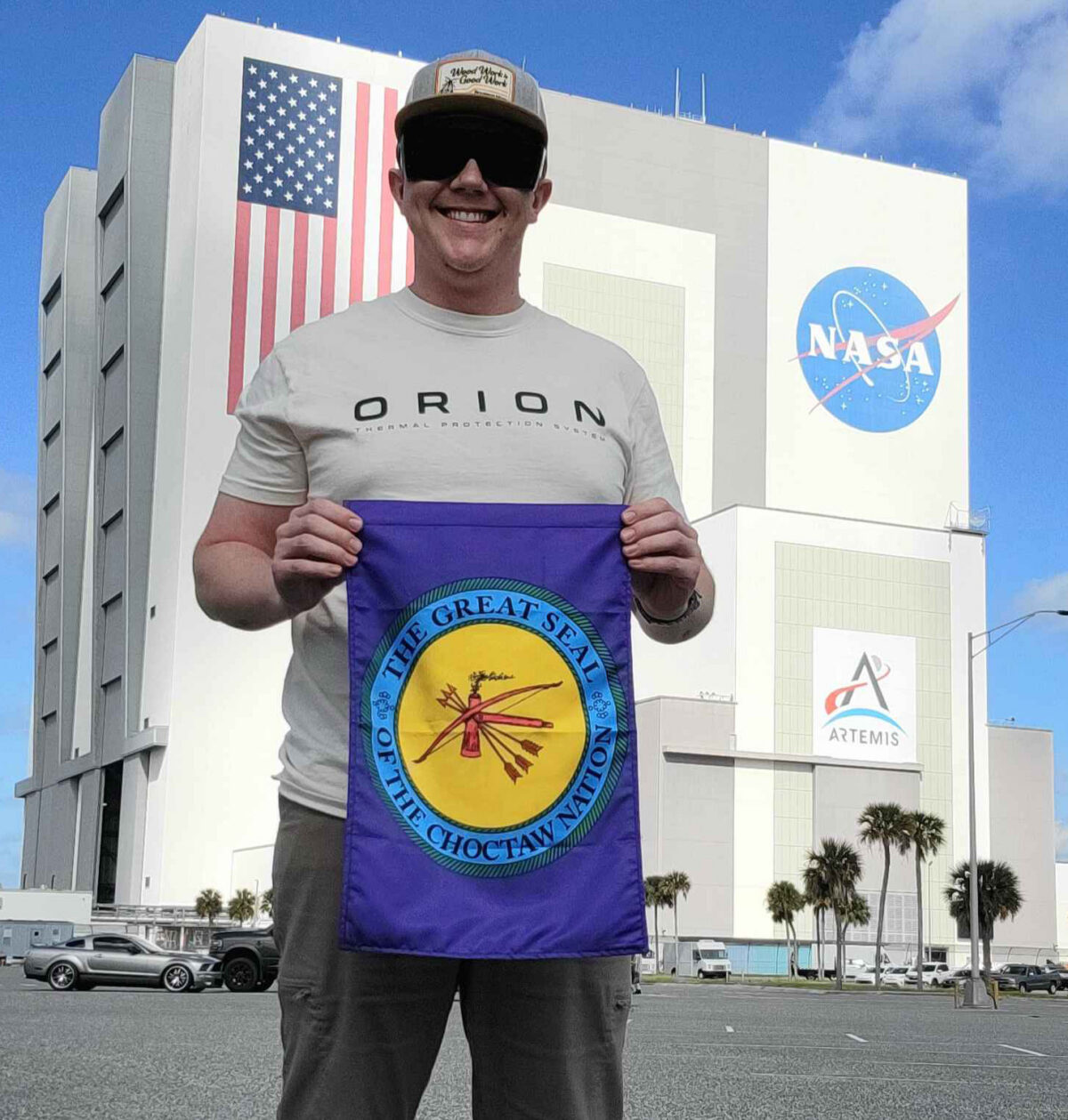
Choctaw tribal member Chris Sorenson is playing a part in this renewed space race. Sorenson works for Lockheed Martin, the primary contractor to NASA for the Artemis missions. He is an Orion systems integration and test engineer on the Assembly, Test and Launch Operations (ATLO) team.
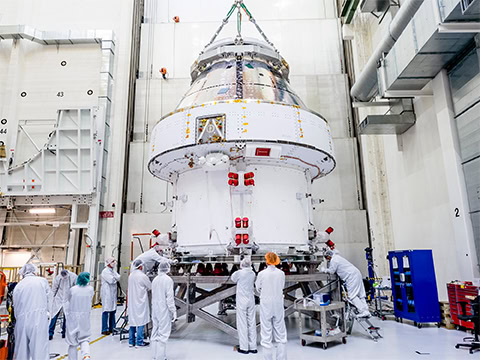
The ATLO team is responsible for integrating the Orion crew capsule, designed by Lockheed Martin, with the European Service Module (ESM). The ESM provides electricity, water, oxygen, and nitrogen, and keeps the spacecraft at the right temperature and on course.
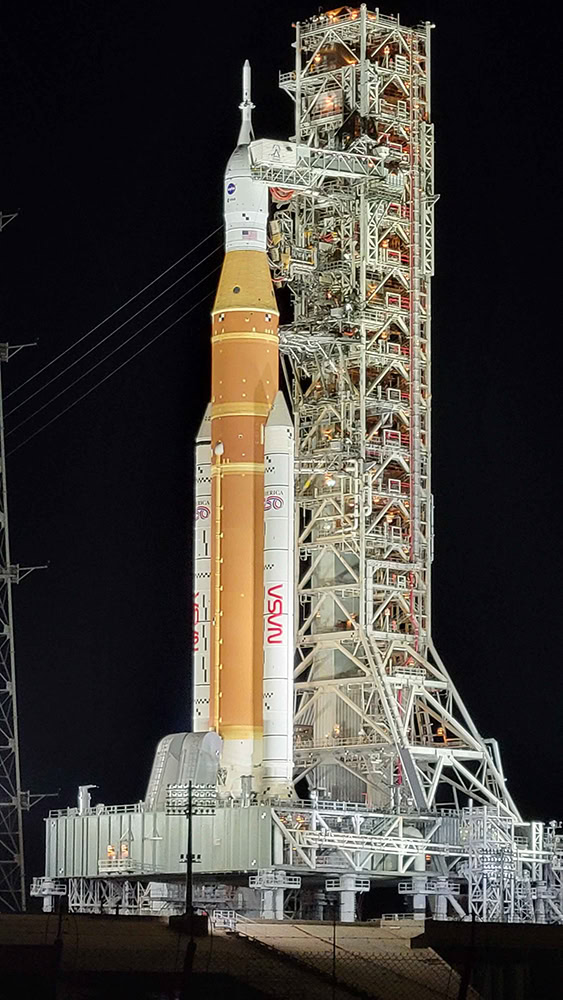
The Artemis program plans to return humans to the moon, starting with the crewed Artemis II flyby, now scheduled for March 2026. This will be followed by the Artemis III lunar landing no earlier than 2027 or 2028. This timeline puts it two to three years ahead of China’s planned manned lunar mission.
Given that the return to the moon by humans is such a milestone for humankind, it is a little surprising that space was not Sorenson’s first choice.
“My first career choice coming out of high school was actually to be a professional musician,” Sorenson said.
After attending music college and working in the industry for a few years, Sorenson had an “existential crisis” that led him to change direction completely.
“I had a sense of my potential to become an engineer and work on spacecraft, but what I knew for a fact was that I needed to at least try,” he said.
Sorenson’s mother, Dawn Sorenson, said she knew from an early age that her son was destined to be an engineer and builder. She said he was interested in many things, but technology and music were his main interests.
“He would always take things apart to figure out how they worked,” Dawn said. “This included one of the first electric guitars that we bought him, much to our chagrin.”
Dawn, who spoke to her son weekly about things going on in their lives, remembers a specific conversation.
“During one of our regular conversations, he said something about missing out on all the great things going on in space advances,” she said. “I asked him why he thought he had missed anything. If he wanted to do that, then go do that.”
Chris left the music industry (for a little while) and focused full-time on getting his degrees, and then an internship with a major aerospace company.
“And now…now his ‘office’ is the space capsule that is sending humans back to the moon,” said Dawn.
Chris sums it up saying, “I reached a point where I could not stand the idea of being an old man and looking back on what could have been – what I could have contributed to humanity’s reach for the stars. From the inception of the idea, my goal never wavered from the simple ‘I want to build spaceships.’”
The astronomer and planetary scientist, Carl Sagan, said, “We began as wanderers, and we are wanderers still.”
From early trade exploration, like the Silk Road, to Viking ships landing on the North American continent, humans have always had a desire to explore.
According to Sorenson, exploration broadens our collective perspective and pushes us to do things we have never done.
“Many of the great advances we have enjoyed on Earth in the past several decades are a direct result of aerospace innovation, and the return-on-investment for these kinds of missions has proven to be one of the best ways that we spend tax dollars,” he said.
It’s not just the innovation that Chris Sorenson thinks is important. It’s the coming together of many nations to accomplish a lofty goal.
As of January 2026, 61 countries have signed the Artemis Accords, a non-binding set of principles guiding sustainable and peaceful space exploration.
“The space industry has grown to be a lush environment for international collaboration. Grand shared goals bring people together on grand scales,” Sorenson said.
As one might expect, Dawn Sorenson can’t hold back the pride she has in her son.
“I, and his brother, could not be more proud of him. He worked very hard and went through many trials to get where he is,” said Dawn Sorenson.
According to Dawn Sorenson, since Chris’ start at Lockheed, he has wanted to find a way to share his story, network with others, and, at every opportunity, encourage more Native Americans to reach for the stars with him.
Chris Sorenson echoed this, saying that we need more people with indigenous backgrounds in space engineering.
“Humanity is on the brink of expanding across new frontiers, and if we wish to ‘do things the right way’ in these new places then we need the kinds of philosophies held by so many Native American tribes,” Chris Sorenson said.
He also stressed the need to find harmony with new environments and the importance of respecting resources.
“We need to have the perspective that we are not mere consumers but participants in the great story of life,” said Sorenson. “That it is our responsibility to be good stewards to all that we intend our children to inherit.”
In Greek mythology, Artemis is known as the Greek goddess of the moon. Her twin brother, Apollo, the namesake of the original NASA lunar missions, is the primary Greek god of music.
It seems that Chris Sorenson’s journey to help put humans back on the moon, via a musical career, may have been written in the stars.