

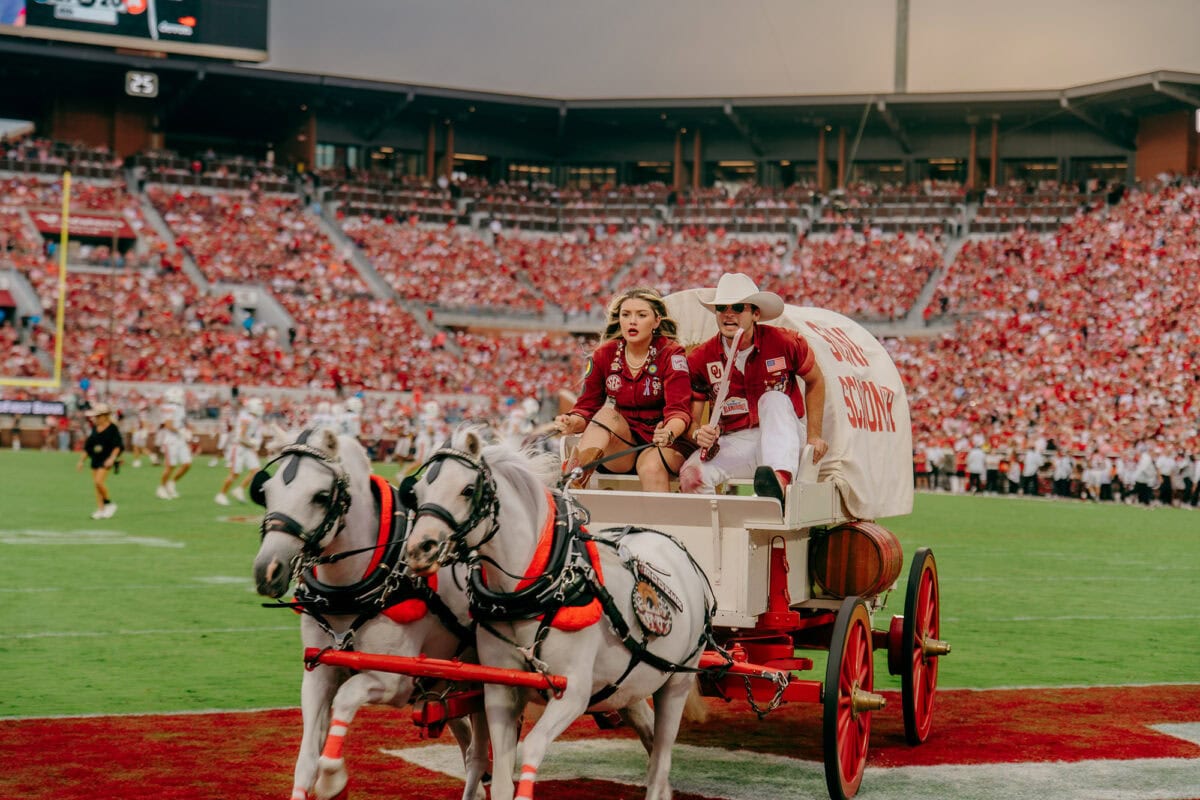
When the Sooner Schooner rushed onto Owen Field during the Oklahoma vs. Illinois State game, fans cheered as they always do for one of the most recognizable traditions in college football.
But this run was different.
Behind the reins was Brianna Howard, a junior at the University of Oklahoma, and the first Native American woman to drive the Schooner.
Howard has always been a passionate Sooner fan.
She grew up taking photos by the Schooner, dreaming of one day being part of the tradition herself.
Now, that dream has become a part of history.
“It felt really great,” Howard said. “I was really happy to be able to represent my tribe and my family in that way. And I mean, it was a huge honor, and I’m really happy that I got to have the chance to do it.”
The road to becoming a Schooner driver is not easy.
Members of the RUF/NEKS and Lil’ Sis undergo a strict selection process, which begins with tryouts and continues through years of training and commitment.
Howard recalled the mix of nerves and focus she felt before making her first drive.
“I guess just like remembering all of my training and knowing, like reminding myself that I knew what I was doing and that even if I was nervous, all the training had prepared me for my muscle memory to take over,” she said.
For Howard, the preparation and long hours paid off in that moment.
While the crowd roared, she carried a quiet awareness that her moment in the driver’s box was also a moment of history.
“I knew as soon as I was selected to be a driver trainee that I would be the first native woman to do it,” said Howard.
Before her, there had only been six women to drive the Sooner Schooner.
Howard also carries her culture onto the field in a visible way.
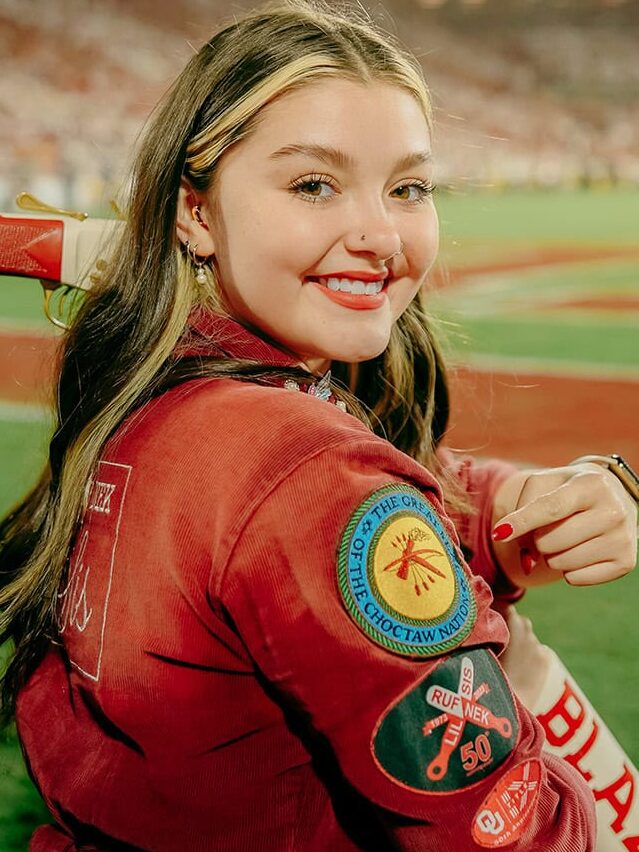
She proudly wears the Choctaw Nation patch on her uniform, a small but powerful way of honoring her family and tribe.
“I feel like it means more now because not only does it make me more recognizable, but it makes the tribe more recognizable to people,” she said.
The support of family, fellow students and her community has been overwhelming.
“The other Native people in my club were really proud of me, and just a lot of people from my mom’s hometown in Talihina,” said Howard.
With media attention following her achievement, Howard has had to adjust to being seen as a role model, though she finds it difficult to see herself that way.
Howard said people often approach her to thank her for the visibility she brings.
Howard, who is majoring in education and hopes to become a teacher, remains focused on both her academic and athletic goals.
“I hope to get a lot more drives in, just to keep going and keep pushing, even though things can get difficult,” Howard said. “I just want to keep showing other Native people, and just people in general, that you can do whatever you want, and they keep going. I really want to be that person that people can look to for inspiration. I also just want to graduate from college and pass my classes. I want to get good grades and make my family proud.”
Howard will graduate next year, but for now, she’s still enjoying every moment of being part of one of OU’s most iconic traditions.
From childhood dreams to a groundbreaking moment on Owen Field, Brianna Howard has carved her place in the history of OU traditions and in the hearts of the Choctaw Nation. Her story is one of preparation, dedication and cultural pride.
“I just hope it goes to show that even if it hasn’t been done before, you can be the first person to do it,” she said. “Even if it’s not that common, you can still do whatever you want, even if it’s not traditional.”