

Every year during Labor Day, tribal members travel from across the country to Tuskahoma, Oklahoma. While there, they spend time with friends and family, participating in the many activities of the Choctaw Nation Labor Day Festival.
While the food trucks, carnival, stickball games, concerts and cultural events are what’s most visible, there’s an entire team working behind the scenes throughout the year to make sure everyone goes home safely.
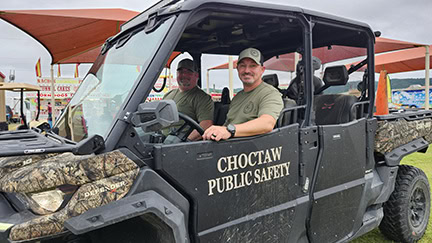
Jeff Hansen, senior director of community protection for the Choctaw Nation, has spent more than a decade helping put that plan together.
From law enforcement, security, EMS and the lost child program, Hansen helps to oversee the safety aspects of the event.
“We participate in the planning process for Labor Day throughout the year,” Hansen said. “That subcommittee consists of basically all of the functions that would be considered public safety at an event.”
One of the things to come out of that planning process is what Hansen calls the Incident Action Plan, a single document that outlines safety objectives for the event and ensures every responder, from fire marshals to radio dispatchers, is working on the same page.
“We also develop for the Labor Day leadership the Incident Action Plan, which is a single document that details the objectives that we hope to achieve during the event, primarily being the safety of our guests,” Hansen said.
GROUNDS SAFETY
During the festival, that plan is referred to daily. Each morning, the safety team meets to go over what’s ahead for that day.
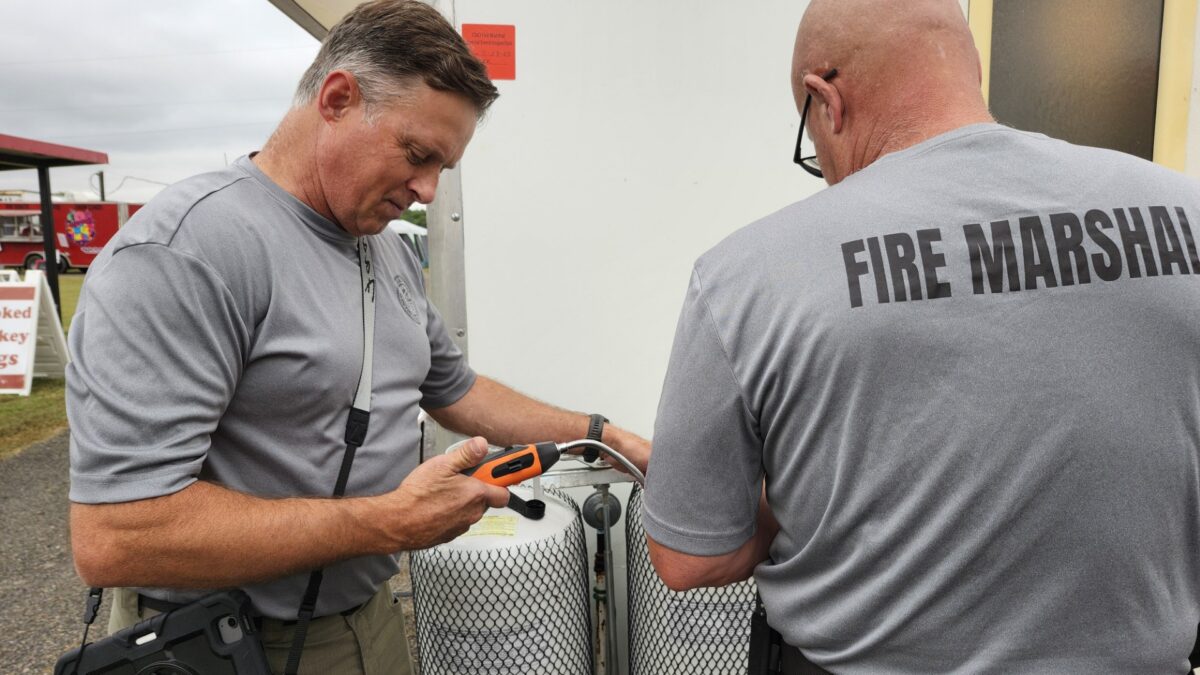
“We have our fire marshals that will do inspections on the food vendor trailers and make sure they’re safe to operate. We have law enforcement throughout the grounds, security throughout the grounds, and we all meet daily to go over that operational period,” Hansen said.
WEATHER
According to the National Weather Service, the three-month temperature trend, which includes Labor Day weekend, will likely be hotter than normal.
Weather is one of the biggest wildcards Hansen and his team have to consider. Southeastern Oklahoma’s late-summer storms can develop with very little warning, and outdoor gatherings elsewhere have seen the consequences firsthand.
A wind gust collapsed a concert stage at the Indiana State Fairgrounds in 2011, killing seven people.
A downburst leveled the Dallas Cowboys’ practice facility in 2009, injuring several people inside. Also in 2015, a storm tore through a circus tent in Angleton, Texas, injuring several.
According to Hansen, the festival relies on several systems to track and respond to severe weather before it reaches the festival grounds.
“If we have severe weather coming in, we need to be aware of what’s going on, and we need to be able to communicate with tribal leadership so they know when we need to take precautions,” Hansen said.
A tornado siren and a lightning detection system are both installed on the grounds.
“We also have a lightning detection system on the grounds that when lightning is detected within five miles from the festival, it sounds off an alarm and has a flashing light,” Hansen said.
According to Hansen, there have been times when he’s had to shut down the carnival because lightning was near the festival grounds.
When situations like that happen, a team of dispatchers stationed in the public safety trailer relays updates over the radio to every area lead on the grounds.
Guests can help keep themselves safe by checking forecasts before heading to the grounds and moving toward one of several enclosed buildings as severe weather approaches. Open fields, isolated trees and standing water should be avoided until a storm passes.
HEAT
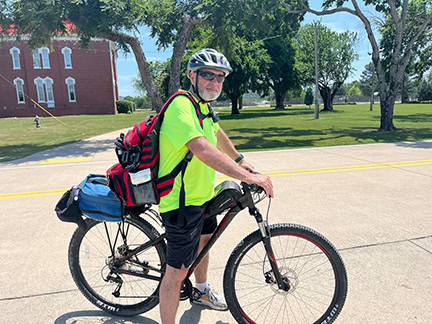
Heat is also a constant concern. Hansen said this year is shaping up to be hotter than recent festivals.
“Weather-wise, heat is always an issue. We’ve had some very nice days over the past few years that were not too hot. This year, I think we’re going to see some pretty significant heat,” said Hansen.
Visitors traveling to Tuskahoma from cooler climates should plan to pace themselves and give their bodies time to adjust to the heat and humidity.
Drinking water consistently throughout the day, rather than waiting until feeling thirsty is crucial. Wearing light-colored, loose-fitting clothing and a wide-brimmed hat can also help festivalgoers protect themselves from the heat.
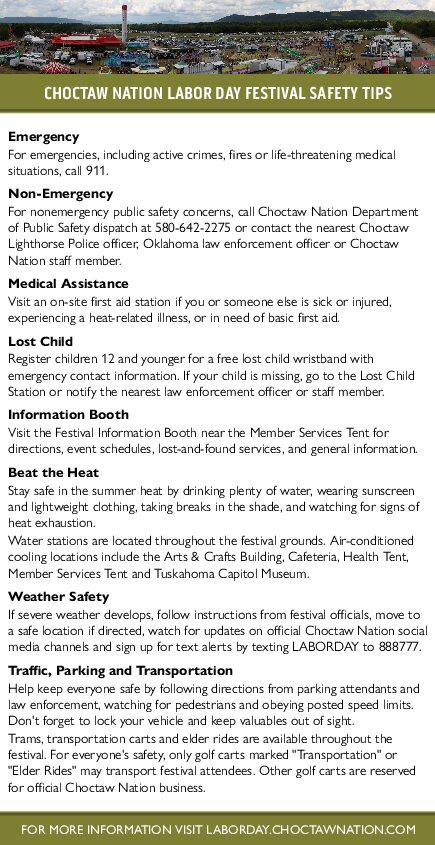
Free water stations are set up throughout the grounds, and several buildings offer air-conditioning to cool off in.
“There are water stations that we set up all over the grounds where people can get water,” said Hansen. “There are also various buildings that people can go into to cool off.”
The CDC says signs of overexposure to excessive heat conditions can begin with heat cramps. Anyone who may experience heavy sweating and muscle cramps in the heat should move to a cool place, drink water or a sports drink, and wait for the cramps to subside.
Signs of heat exhaustion include heavy sweating; cold, pale, clammy skin; fast, weak pulse; nausea or vomiting; muscle cramps; tiredness or weakness; dizziness; headache; and fainting. If you or someone around you is experiencing these symptoms, move to a cool place, loosen clothes and place a cool, wet cloth on the neck, armpits and/or groin.
At the festival, the first-aid tent near the capital museum is staffed with nurses and doctors. Anyone who overheats or gets hurt during a stickball game or other activity can be treated there.
According to Hansen, ambulances will be on standby for anyone who needs to be taken to a hospital.
LOST CHILD
Lost children are among the most common calls Hansen’s team handles at the event each year.
The festival’s wristband program, located at the Lost Child Station near the Council House, is one of the best ways to quickly reunite families.
Parents and guardians can register children aged 12 and under and receive a wristband loaded with emergency contact information. If a child is found without a parent nearby, staff can check the band and call the parent directly, rather than broadcasting a description over the radio and waiting for someone to spot the child.
According to Hansen, the band will have the parents’ name and contact information on it.
“If there’s a child that we find that can’t find their parents, we can look at that band and get that information. We can just call the parents and say, ‘hey, we’ve got Johnny here, and we need to get you guys back together,’” said Hansen.
Hansen encourages all parents attending the festival to sign up for the wristband to help ensure the safety of their children.
“That (wristbands) has been such a huge help to the responders and to the event staff, because we’ve been able to reunite parents with their children much faster,” Hansen said.
SECURITY
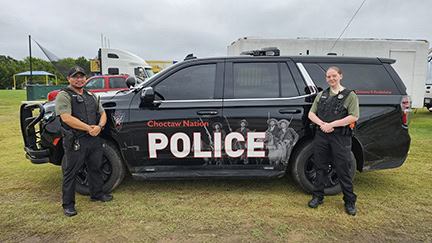
The Choctaw Nation Lighthorse Police will be stationed throughout the grounds as well, alongside first-aid and lost-child staff, radio dispatchers and an aerial drone team that monitors traffic flow to help spot traffic backups before they grow.
After years of watching the festival grow, Hansen said the coordination between all those teams is what keeps guests safe without getting in the way of the celebration.
“I think behind the scenes, it’s coordination. It’s making sure that we’re all working from the same sheet of music,” Hansen said. “The Labor Day Festival has always been a very safe event, and I think that’s because of who we are.”
It’s important to make sure you take care of your family, especially elders, especially in the heat and when it comes to staying hydrated. Thanks to the behind-the-scenes planning, attendees can do all of that and still have fun.
For more information about this year’s Labor Day Festival and to view the 2026 festival’s interactive map, visit laborday.choctawnation.com.