

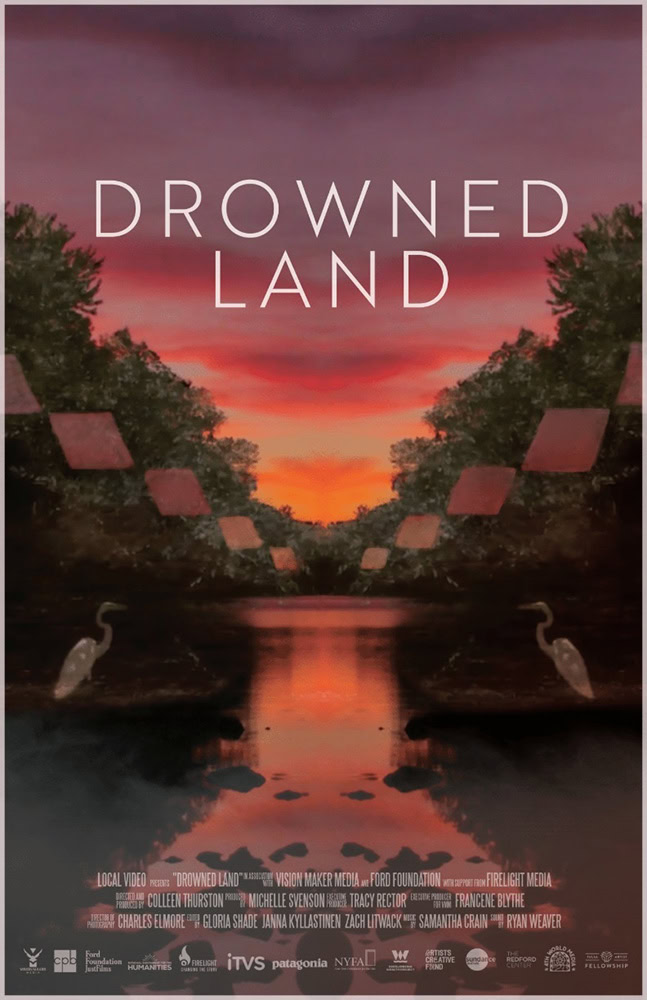
The documentary “Drowned Land” tells the story of how citizens in Oklahoma are working to preserve their communities and halt the exploitation of the Kiamichi River. It has been shown around the country, recently ending its tour with six viewing locations within the Choctaw Nation Reservation.
Choctaw storyteller, producer, film curator and Tulsa-based filmmaker Colleen Thurston was inspired to direct the film, which spotlights Oklahoma’s Kiamichi River and local water stories, as well as those of her grandfather’s relationship with the lakes of the Choctaw Nation. She exposes projected plans for the river area that include the building of a hydroelectric plant by a Texas corporation, potentially destroying the land and displacing its communities.
The film was seven years in the making and features information about how the industrialization of southeastern Oklahoma’s Sardis Lake and the Kiamichi Area River Valley has negatively changed what has existed for generations. It recounts the struggle of water protectors fighting to preserve the Kiamichi River from environmental exploitation, encompassing both present-day and historical struggles.
The film also visits the challenges local farmers and Indigenous residents are facing because of these changes, at times being eerily similar to displacement issues Indigenous peoples faced generations ago.
Thurston explained, “This is a source of life-giving water, and the risk that diversion and commodification bring not only threatens the river’s survival but that of its surrounding communities. My hope is that by connecting our peoples’ history of displacement due to resource extraction with the present-day struggle of water protectors, “Drowned Land” can offer a glimmer of hope that there are real solutions.”
Dr. Kenneth Roberts, a native of southeastern Oklahoma and chair of the Department of Chemistry and Biochemistry at the University of Tulsa, was one of the film’s featured participants and said, “This isn’t about money, it’s to preserve a culture, a way of life, a heritage, that you just can’t replace.”
“Drowned Land” highlights the protective work being done in the heart of the Choctaw Reservation today.
The presentation also featured the work of artists and journalists who used storytelling expertise to elevate water issues across the region.
KOSU-NPR reported that, “Natural resource exploitation and displacement are the film’s central themes. “Drowned Land” reflects examples of the manipulation of the earth to serve the needs of more populated areas in the state.”

The documentary, which includes interviews and on-the-ground footage, premiered to a sold-out audience at the Environmental Film Festival in Washington, D.C., and was selected to launch Color Congress’s inaugural Elev8Docs Multi-City Campaign, with simultaneous community screenings in Los Angeles and Santa Fe.
It also ran at other major festivals, including the Seattle International Film Festival and the Lumbee Film Festival in North Carolina.
“Drowned Land” won the 2025 Best Documentary award at the sixth annual Circle Cinema Film Festival in Tulsa.
It also received the award for Best Oklahoma Documentary at the deadCenter Film Festival in Oklahoma City, and Thurston was named Best Emerging Filmmaker at the Thin Line Festival in Texas.
Thurston’s work has aired on the Smithsonian Channel, Vox and PBS, and she has been commissioned by museums, tribal nations and nonprofit organizations.
Her films have been screened at international festivals and received wide support.
She is a founding member of the Indigenous Moving Image Archive, which has presented and curated numerous programs and film festivals, is the project producer for the Indigenous series Native Lens and is a senior programmer for the Hot Springs Documentary Film Festival.
Thurston is a 2024-25 International Documentary Association fellow and a 2025-27 Tulsa Artist Fellow. “Drowned Land” is her first feature-length documentary.