

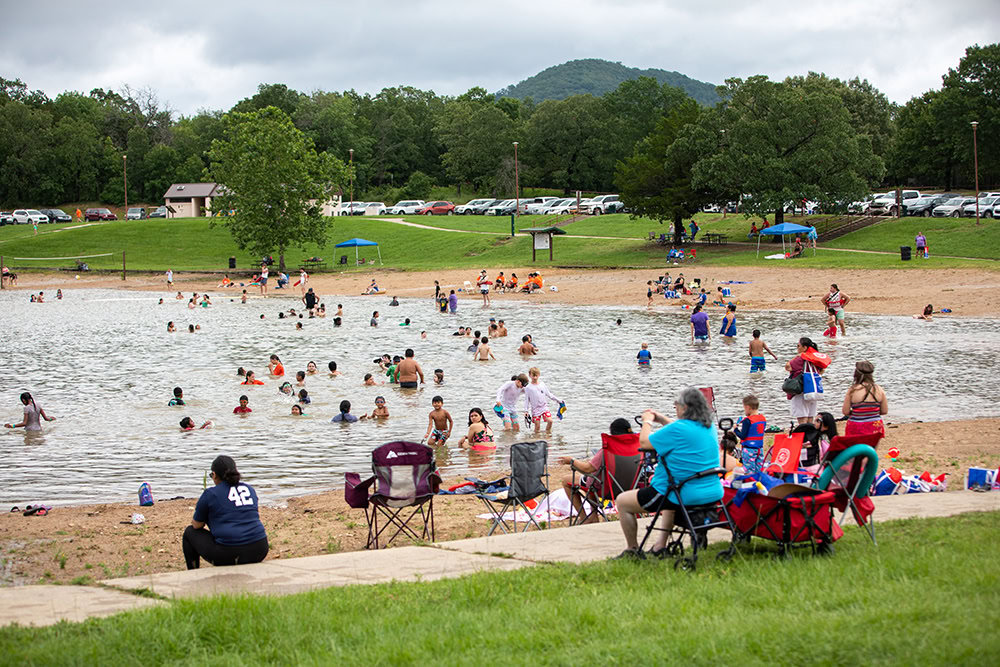
Water is the lifeblood that flows through our culture.
Water has provided Choctaw families with food, helped grow medicines, and made it possible to trade and travel.
Water defined the Nation’s borders in the Treaty of Dancing Rabbit Creek. When Choctaw ancestors arrived in Indian Territory, they built new lives along these rivers, running ferries and water-powered mills. Learn more about the natural resources and their history on the reservation at the Choctaw Cultural Center’s temporary exhibit “Our Lands, Our Legacy,” through April 18, 2026.
Protecting Water Resources
Water is just as important today as it was for Choctaw ancestors after the Trail of Tears.
That’s why the Choctaw Nation works to protect water sources for everyone living on the reservation.
Ahndria Ablett leads the Water Resource Management Office. Her team monitors water quality, helps develop water policies at the local, state and federal levels, supports watershed conservation, provides resources to communities and plans for future water needs. Programs under her leadership include water policy and planning, sustainable communities, research and data acquisition, watershed management and surface mining.
When asked what she is most proud of about her role, Ahndria said, “I am proud of the work I am doing today because it will benefit future generations after I am gone.”
For Ahndria, her work reflects her belief in being a servant for God and his people, inspired in part by her mother-in-law, Shirley (Carnes) Duran.
“She told me that we are here for others and that is how we are best servants for God and his people. The river does not flow to give itself life. It flows for others, to sustain them, to nourish their bodies as it flows to the sea. She said that as we flow through life, we help and love others as we flow to our final destination,” said Ahndria. “I have taken her words to heart, and this is what I aspire to each day in service to the Choctaw Nation, its tribal members and all communities within the Choctaw Nation reservation.”
Ahndria’s team also shares this commitment to servant leadership and supporting future generations.
Reanna Workman, water resources senior planner, said, “Water is a huge, quiet part of the community that has been at the center of everyone’s lives since the beginning of us. Not everyone gets to say that they change a generational amount of lives every day.”
Jeremy McBride, WRMO’s sustainable communities manager, said, “I am most proud of the positive impact our Sustainable Communities team is having on our communities. None of this would be possible without my team, Mark Shelton and Jordan Mooney. We are becoming synonymous with a helping hand in the world of water and wastewater infrastructure.”
When asked about their most memorable work, everyone mentioned helping local rural water systems.
Ahndria said her most memorable work is when “we can provide resources for water infrastructure improvements in places like Sardis Lake Water Authority that would normally not have the funds or ability to get those resources any other way.”
Both Reanna and Jeremy stated that the help their team has provided to the LeFlore Rural Water District #17 has been among their most memorable work to date.
“Originally, all we had to offer was technical support, but when additional ARPA funds became available, it was an easy decision to recommend them,” Reanna said. “The chief didn’t hesitate and immediately agreed with our recommendation. Telling them that the project they desperately needed would finally be funded, with $2.3 million in CNO ARPA funding, was an emotional moment. It was incredibly rewarding to help people who work so hard for their community and make such a meaningful impact.”
“This water system is tiny and is run by a group of mostly volunteers, and they were staring at millions of dollars in work that needed to be done to not only reduce their large amount of water loss, but to maintain state compliance,” Jeremy said. “When we told them that Chief Batton had agreed to fund their project 100% with zero cost to the district, their response was emotional. It was that moment when I knew that what we were doing here with the Choctaw Nation was having a major impact on people’s lives.”
Thanks to these partnerships and the dedication of those running each system, both Sardis Lake Water Authority and LeFlore Rural Water District #17 received “Water for 2060” excellence awards at the annual state conference. These awards honor outstanding efforts in promoting water-use efficiency and conservation in the state of Oklahoma.
Advancing Sovereignty: Water Settlement Agreement
Water is closely tied to sovereignty, which includes CNO’s responsibility to care for the communities and land on the reservation now and for future generations.
The Choctaw and Chickasaw nations signed the Water Settlement Agreement with the state of Oklahoma, which affirmed the Nation’s sovereignty over the protection of water resources on the reservations. Parties have a common interest in long-term sustainability of water resources under the agreement (Section 9.2).
The Water Settlement Agreement is one of the first of its kind.
At its heart, the agreement is about working together to protect water through partnership, sustainability, and respect for the land and the people who rely on it.
The Water Settlement Agreement gives priority to local use and protects lake levels and in-stream flow for Sardis Lake located in Pushmataha and Latimer counties.
It limits how much water can be taken from cities outside the reservation, such as Oklahoma City, and requires the city to maintain a standard conservation plan with special considerations during extreme drought conditions. Since the agreement is federal legislation, it is enforceable in federal court.
Citizens Supporting Water
Tribal members have many ways to help protect water resources for today and for future generations.
Watch what goes down drains and yards. Runoff from feces, fertilizers, and pesticides increases nutrients, causing harmful algae and poor water quality in lakes and rivers.
It is important to use water wisely. Individuals should avoid overwatering, plant native Oklahoma grasses, keep grass a bit longer and prevent runoff. It is also essential to follow community water conservation measures.
Practice water conservation at home and outdoors to protect clean, reliable water for future generations.
Use best management practices in commercial, agricultural and industrial sectors, even if they cost more now, to prevent higher costs later.
Support responsible water rates and stay involved. Water fees fund treatment, infrastructure, and operations—attend board meetings and advocate for improvements.
Water Operator Renewal Training
OWRM offers free water operator renewal training for certified water operators in Oklahoma. The training includes hands-on instruction focused on the operational, maintenance and regulatory aspects of water treatment systems and facilities.
Participants will earn the in-person continuing education hours required to renew their Oklahoma water operator licenses.
The next training offered will be in May at the Choctaw Community Center in Poteau, Oklahoma.
For more information, contact Mark Shelton, Water Infrastructure Planner.